

Böll EU Brief
Green euro rising: Positioning the euro as the world’s green currency
Böll EU Brief 06/2025
Key findings:
-
US monetary policy shifts offer a strategic opening for the EU. This is a moment to elevate the euro’s global role. In this age of geoeconomic rivalry, a stronger international euro would bolster EU strategic independence, shield it from extraterritorial shocks and reduce exposure to weaponised interdependence.
-
From the greenback to the green euro. As Washington retreats from sustainable finance, the euro can become the world’s leading ‘green currency’. The new US administration’s fossil fuel bias and regulatory hostility towards sustainable finance contrast with the EU’s regulatory clarity, ECB policies and green finance leadership. Euro-denominated green debt and ESG investments have surged, demonstrating global demand and trust in euro-based sustainable finance.
-
To seize this green ‘euro moment’, the EU must align policy with ambition. It should restore policy coherence, strengthen green finance regulations and enhance enforcement. It should integrate the euro into trade policy, incentivise euro invoicing and task the ECB with a clear green internationalisation strategy. These steps would deepen capital markets, drive innovation and position the euro as the backbone of global clean energy finance.
The new US administration has uprooted the very foundations of the post-war international monetary order. Christine Lagarde aptly called this the ‘euro moment’, a geopolitical opportunity to strengthen Europe’s global standing by expanding the euro’s international use. Europe’s growing role in sustainable finance, its regulatory clarity and the European Central Bank’s integration of climate considerations into its policies create a unique opening: to make the euro the currency of choice for the financing of the green transition, at home and abroad.
This policy brief examines the potential for ‘green internationalisation’, assesses how well the euro is positioned to take on this role and proposes a practical policy roadmap for EU institutions to accelerate progress.
History teaches us that regimes seem enduring — until they no longer are. Shifts in global currency dominance have happened before. This moment of change is an opportunity for Europe: it is a “global euro” moment. To seize it and enhance the euro’s role in the international monetary system, we must act decisively as a united Europe taking greater control of its own destiny.Christine Lagarde (ECB President), 'Europe’s “global euro” moment', 17 June 2025
Internationalising the euro while promoting the global clean energy revolution
For decades, EU policymakers have struggled to advance the international role of the euro.¹ Despite over 30 years of debate about positioning it as a systemic competitor to the US dollar, the euro’s reach has only modestly extended beyond that of the European currencies it replaced. In 2023, global monetary authorities still held 58% of their reserves in dollars compared with just 20% in euros.²
The dominance of the dollar is even clearer in foreign exchange markets, where it featured in 88% of all over-the-counter transactions, against 31% for the euro – only a slight increase from the 30% share of the Deutsche Mark before the euro’s introduction.
Policy initiatives to deliberately strengthen the euro’s international role remain almost absent. Few examples include the provision of swaplines to non-euro EU Member States and neighbouring countries. Despite more than three decades of debate on establishing it as a systemic rival to the US dollar, the euro’s international reach remains striking.
Meanwhile, euro internationalisation can support the geostrategic position and resilience of the EU in an increasingly multipolar international order. It can enhance Europe’s strategic independence by avoiding an international payment landscape where European companies are exposed to US sanctions. It also offers third countries an alternative for the increasingly aggressive US efforts to dollarise the part of the world economy not within its reach, for example, through stablecoins.³ Internationalising the euro would support the broader EU efforts to maintain a rules-based trade order.
Likewise, and this is our focus in this brief, promoting the international euro would contribute to the objectives of the Paris agreement – arguably a duty of the EU in light of the agreement’s Article 2(1)c and its aim of ‘making finance flows consistent with a pathway towards low greenhouse gas (GHG) emissions and climate-resilient development’.
From the greenback to a truly green currency
The close link between international currencies and energy is not new. The pound was the currency of the coal age. In the post-war era, the dollar took over its role as the global currency, with a crucial role for the pricing of oil in dollars. Today’s clean energy era will also need to be funded, but in which currency?
The US, as a fossil fuel exporting jurisdiction, promotes fossil fuel investments. This sustains global dependence on carbon-intensive energy sources and delays the transition to cleaner alternatives. Such a stance directly contravenes the net-zero roadmaps of the International Energy Agency (IEA), which are incompatible with additional fossil fuel supply projects started after 2021. US regulators have also restricted domestic banks from systematically screening for Environmental, Social, and Governance (ESG) risks, while political pressure is also directed at asset managers, such as BlackRock and other financial market players, to discourage climate-aligned investment strategies.
Unsurprisingly, the US has also long obstructed decarbonisation efforts in key institutions of the global dollar system, such as the International Monetary Fund (IMF) and the World Bank.
Globally, the climate investment gap is also widening due to US obstructionism. The IEA (2023) estimates that USD 4.5 trillion in annual investments are required to meet climate goals. In the EU alone, this translates into EUR 400 billion each year. Meanwhile, high funding costs continue to be a major obstacle to the global clean energy transition.&sup4 Energy projects, such as power plants or renewable installations, require very large upfront investments and operate over long time horizons.
GRAPHS 1a & 1b: Exponential growth of green bonds by country and currency (in billions of USD)
Data: Bank of International Settlements, Growth of the green bond market and greenhouse gas emissions (March 2025). Design: Joan Lanfranco | Flourish.
Europe’s growing role in sustainable finance, its regulatory clarity and the European Central Bank’s integration of climate considerations into its policies create a unique opening: to make the euro the currency of choice for the financing of the green transition, at home and abroad.Agnieszka Smoleńska
Because the initial capital outlay is so high, the interest and return payments to investors form a major share of the overall cost of producing electricity. This makes the sector heavily capital intensive, with financing conditions playing a decisive role in determining the final price of energy.&sup5 Meanwhile, comparative studies show lower costs of capital for renewable energy projects in Europe, with euro issuers also benefiting from a greater pool of interested investors.&sup6
A green euro opportunity
The euro is already the currency for clean energy financing globally. Euro-denominated green debt has expanded rapidly, both within the EU and beyond. Within the EU, outstanding green, social and sustainability (GSS) bonds in the euro area have risen to EUR 2 trillion, representing about 8% of the market, compared with just 2% in 2021.
Beyond the euro area, in several Central and Eastern European countries that have not yet adopted the euro, around half of all green loans are in euros. Outside of the EU, in 2020, more than half of all green bond issuance was denominated in euros, a trend that has continued since. Major corporations and sovereigns have also tapped this market, with Apple issuing a EUR-2-billion green bond in 2019 and Saudi Arabia issuing a euro-denominated green bond this year.
While the uptake of EU taxonomy-aligned instruments has been relatively slow, it is still estimated at EUR 250 billion, alongside additional EUR 260 billion of investments by companies with credible transition plans. Europe is also becoming a ‘safe haven’ for sustainable investing: 84% of the USD 3.2 trillion held in ESG funds managed in Europe, a trend strengthened by recent regulatory and political developments in the United States that have redirected flows towards European markets.
There are four reasons why the EU has achieved success in green finance.&sup7 First, the EU’s sustainable finance policies have established common regulatory foundations, product and service standards, and information requirements that embed climate considerations across the economy. Second, the European Central Bank has progressively integrated climate change into its monetary policy and supervisory activities, addressing financial risks while also acting in line with Treaty obligations, including Article 11 of the TFEU.
Third, the EU budget has been reshaped through the NextGenerationEU framework, which incorporates binding green rules to channel recovery spending towards climate-related investment. Finally, the EU itself has become a major issuer of green bonds, with EUR 73 billion outstanding – about 10% of its total issuance – while also mainstreaming climate concerns into the EU budget and related policy frameworks.
Together, these measures create a regulatory, financial and institutional (macrofinancial) environment that supports the credibility and investor trust in euro-denominated green debt.
Despite half a decade of talking about the internationalisation of the euro and the EU green transition as an engine of European competitiveneness, progress has stalled due to chaotic regulatory rollbacks and shifting policy priorities in Brussels. The EU appears to have deprioritised green and transition investments in its budget and external policies. Meanwhile, China has also made massive efforts to enable favourable and clear conditions for green financing.&sup8
Results are visible: while a few market leaders have begun to issue bonds under the EU Green Bond standard, the trend here remains subdued.
The EU leaves firms and investors confused about the future of energy transition investments. The European Central Bank (ECB) has sounded the alarm bell on the implications of the EU regulatory rollback for financial stability and monetary policy functions. In other words, the moment first results of the policy were beginning to show, the EU scores an own goal.&sup9
GRAPH 2: Green bonds as a percentage of total bonds issued by corporations, by governments, and by both corporations and governments in the EU-27, 2014-2024
Data: European Environmental Agency, Green bonds in Europe (July 2025). Design: Joan Lanfranco | Flourish.
Already today, the Euro plays a significant role in green financial markets. EU policy makers should play to that strength by promoting the Euro as the currency of the green transition rather than creating uncertainties by undermining its own regulations for sustainable finance.Jens van ‘t Klooster
Policy recommendations
While currency internationalisation is a complex and multifaceted process, EU policymakers should not underestimate the trust that the EU has built as a currency of the green transition – a concept first introduced by Eurogroup President Pascal Donohoe back in 2021. It is imperative that Europe gets back on track.
Most immediately, the EU legislature should pay much more attention to the negative effects of the ongoing ‘Omnibus’ agenda. A global currency needs clear rules and reliable information for investors. Sustainable corporate governance rules support credible green finance instruments and monitoring of progress, driving investor confidence and demand. Crucially, policy consistency on the goals and tools to achieve the EU green transition offers certainty to real economy actors already facing multiple challenges. The EU should deepen and standardise the market for green financial products, anchoring global issuance and investment in a consistent rule set.
Meanwhile, sufficient resources should be dedicated to the implementation and enforcement of green finance standards by EU financial authorities and national agencies. The EU has a unique opportunity to further drive innovation in green finance and support further capital market development, tailored to the specificities of markets with heterogenous transition financing needs.
Currency internationalisation depends heavily on cross-border supply chains, which generate demand for offshore money denominated in that currency – or, as Pozsar and Sweeney (2020) put it, ‘the supply chain is a payment chain in reverse’.10; There is ample scope for integrating the euro more prominently into the EU’s trade policies, in particular pertaining to the export of clean energy capital goods. In its new trade agreements and the foreseen trade and investment partnerships, the European Commission can promote euro-denominated transactions. Member States can offer euro-invoicing incentives for export finance.
Finally, the ECB should develop a coherent account of how to promote the green euro. The central bank always plays a pivotal role in supporting international use of currencies.11; While the ECB takes the promotion of the euro as part of its monetary policy task, it still lacks a detailed roadmap for how to give effect to this effort internationally. A powerful green internationalisation strategy should be devised on the basis of its secondary mandate.
Footnotes
1 Ilzetzki et al., ‘Why is the euro punching below its weight?’, 2020; van ’t Klooster & Murau, ‘Rethinking currency internationalization: offshore money creation and the EU’s monetary governance’, 2025.
2 European Central Bank, ‘The international role of the Euro’, June 2024.
3 van ‘t Klooster, Martino & Monnet, ‘Cryptomercantilism vs Monetary Sovereignty’, 2025.
4 Sweerts et al., ‘Financial de-risking to unlock Africa’s renewable energy potential’, 2019.
5 OECD, ‘Bridging the clean energy investment gap: Cost of capital in the transition to net-zero emissions’, 2024; Wilson, Shrimali & Caldecott, ‘Financing Costs and the Competitiveness of Renewable Power’, 2025.
6 Oxford Sustainable Finance Group, ‘ETRC – Cost of Capital and Investment Tracking’, 2024.
7 Smoleńska, ‘Euro as the currency of the EU’s Green Transition’, 2022; Tokarski, ‘The Euro in a World of Dollar Dominance’, 2024.
8 DiLeo, Helleiner & Wang, ‘A Less Reluctant (Green) Atlas? Explaining the People’s Bank of China’s Distinctive Environmental Shift’, 2025; Net Zero Industrial Policy Lab, ‘China’s Green Leap Outward: The Rapid Scale-up of Overseas Chinese Clean-Tech Manufacturing Investments’, 2025.
9 European Central Bank, ‘Opinion of the European Central Bank on proposals for amendments to corporate sustainability reporting requirements’ 2025.
10 Pozsar & Sweeney, ‘Covid-19 and global dollar funding’, 2020.
11 Helleiner, ‘States and the reemergence of global finance: From Bretton Woods to the 1990s’, 1994.
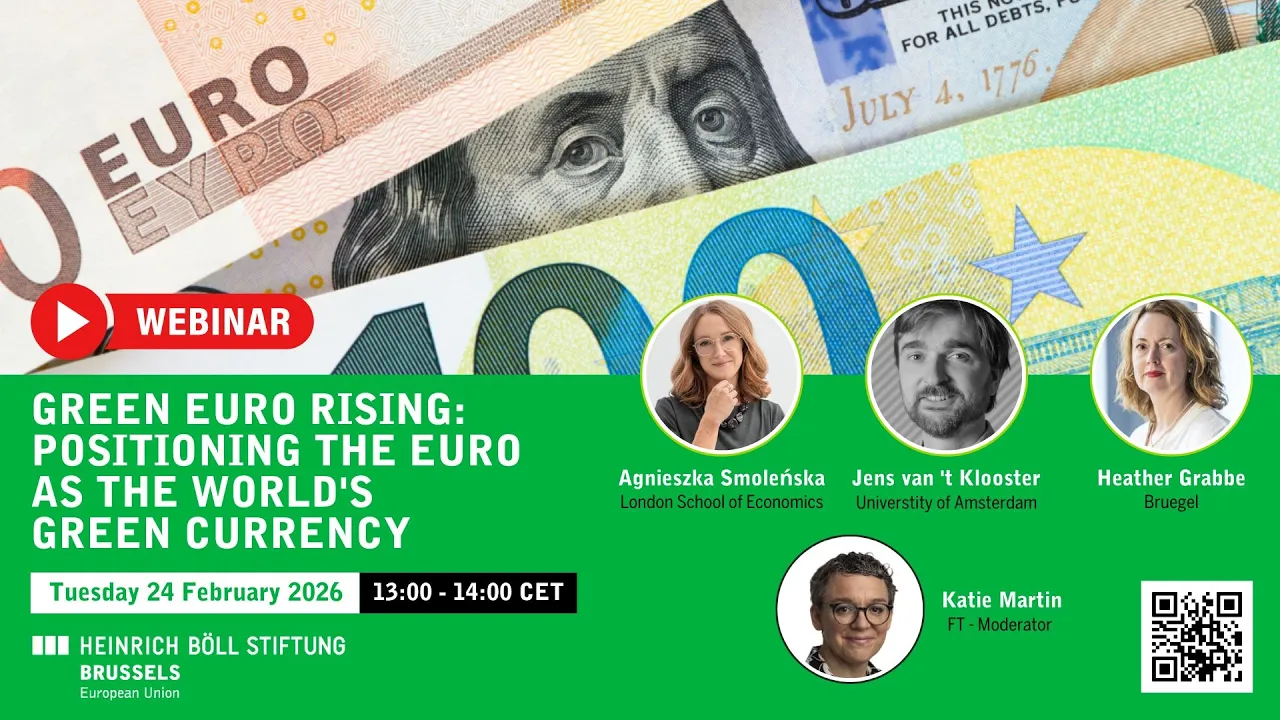
Webinar recording
Green euro rising: Positioning the euro as the world's green currency - Heinrich-Böll-Stiftung EU | Global Dialogue
 Watch on YouTube


